

Named Patient Programs
How Do NPPs Enable Compliant Treatment Access?
Named Patient Programs (NPPs) provide a compliant regulatory pathway that enable companies to supply medicines in response to unsolicited request from healthcare professionals (HCPs), in countries where the product does not have a marketing authorization and when there is a clear medical need with no comparable alternative treatment options available. While this is most common when a product has received a marketing authorization in at least one country in the world, most countries also permit companies to sell products that are still in an investigational phase.
Tanner Pharma is a full-service partner for sponsors seeking to enable immediate patient access while building toward a more structured, fully managed access program or a defined pathway via NPPs.

Through NPPs, we support sponsors at the earliest stage of access, providing a compliant starting point to respond to urgent patient needs while maintaining control over distribution strategy. Tanner Pharma advises on country-specific feasibility for obtaining funding for treatment in an unlicensed setting, identifying available funding sources in each country, guiding patients and HCPs on how to obtain access for funding, supporting program pricing strategies, and managing the process for securing funding.
Given increasing market access challenges and the development of more treatments for smaller patient populations, the demand for NPPs as a core component of a company’s global asset strategy has significantly increased. With decades of experience, Tanner Pharma supports sponsors in designing, executing, and optimizing NPPs to responsibly expand patient access while maintaining regulatory compliance and operational excellence.
Not Sure Where to Start?
Explore our Medicine Access 101 guide for patients and HCPs.
Scenarios for Named Patient Programs
Sponsor needs to generate revenue while a product is still in an investigational phase.

Sponsor wants to provide access but is not in a position to provide the product for free.

Sponsor is not certain of its commercialization footprint or does not achieve the price it requires in a market.

Sponsor wants to take advantage of programs in countries which explicitly reimburse products ahead of marketing approval.

Sponsor wants to support continuity of care when a product is approved, but local pricing, reimbursement, or distribution is not yet in place.

Sponsor wants to maintain control of supply in approved markets but requires a compliant pathway to deliver medicine to patients that have an urgent unmet medical need and approval timelines do not align with clinical urgency.

Sponsor has not yet determined the program's pathway but requires immediate patient access while preserving strategic flexibility.

-
1. When should a Sponsor consider using an NPP?
NPPs are typically used when immediate patient access is required, but a full managed program or commercial launch is not yet in place. They allow sponsors to respond quickly while maintaining regulatory compliance and control over distribution.
2. Can NPPs be used for investigational or pre‑approval products?
Yes. While NPPs are commonly used for products approved in at least one country, many jurisdictions permit access to investigational or pre‑approval products when there is a clear unmet medical need and no suitable alternatives.
3. When is the right time to start with immediate access rather than a fully managed program?
Immediate access is often the right starting point when patient need is urgent, demand is uncertain, or the broader access strategy is still being defined. It allows sponsors to respond quickly while preserving flexibility to transition into a more structured, managed program as demand and market clarity increase.
4. Can immediate access be implemented while the long‑term access strategy is still under development?
Yes. Immediate access programs are frequently used as an interim solution, enabling patient access while sponsors finalize decisions around pricing, reimbursement, country prioritization, and the timing or structure of a more managed access program.
Core Services
Program Management
Pharmacovigilance
Regulatory Compliance
Quality Assurance
Supply Chain & Logistics

Program Management
Regulatory Compliance

Pharmacovigilance

Supply Chain & Logistics

Quality Assurance

How We Deliver Access Solutions
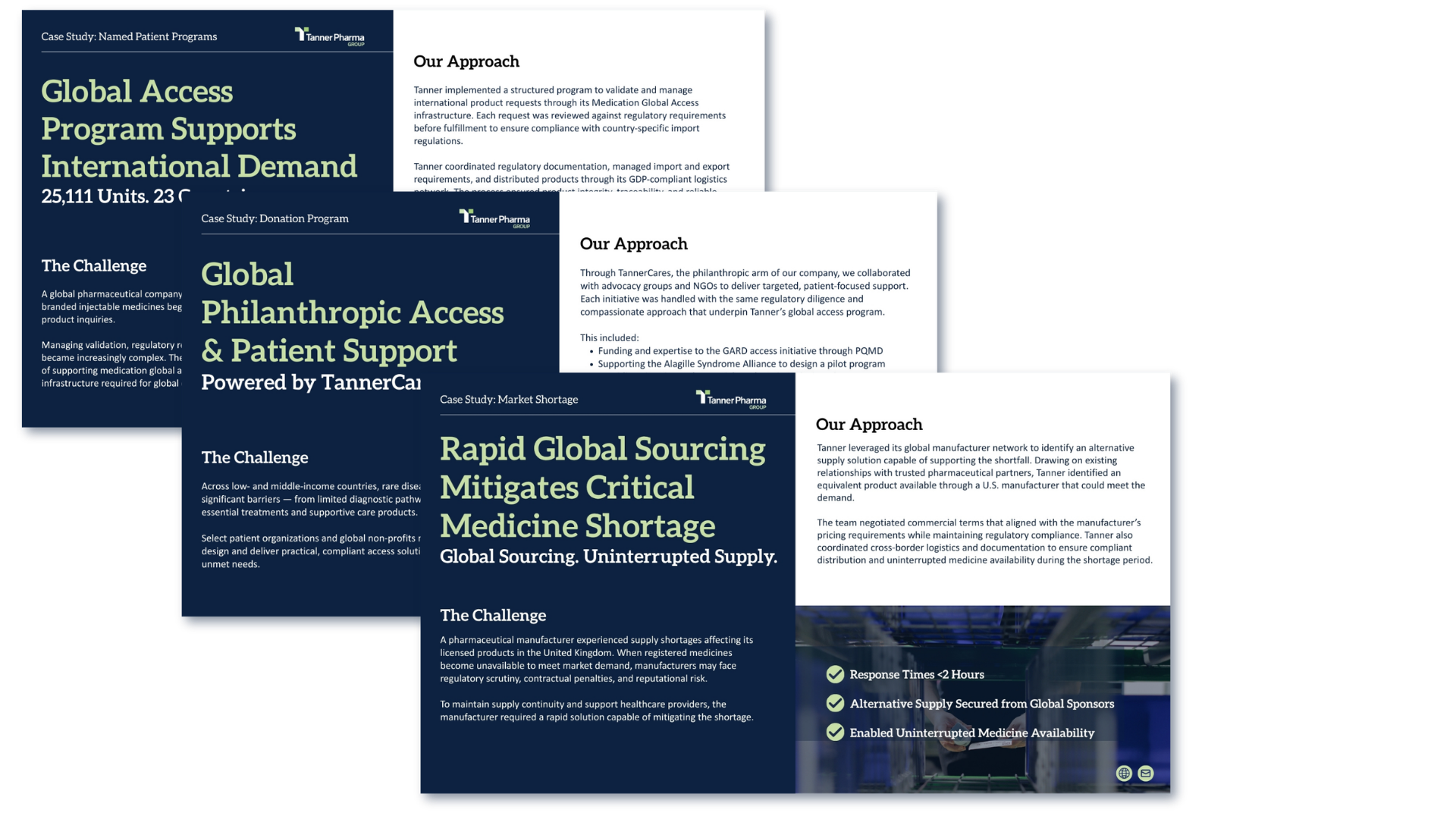
Explore real-world examples of how we navigate regulatory, geographic and supply complexities to deliver compliant, global access to essential therapies.